Last updated November 18, 2026


Free written scope consultation - allowances, timeline, and change-order rules on paper before a single trade is scheduled
Fence Installation Troubleshooting: Common Problems and How to Fix Them
A leaning fence post is not evidence that the post itself failed. In our experience across Miami Gardens, roughly 70% of the leaning posts we’re called out to inspect have sound lumber above grade and a footing that was undersized for the soil it sits in. That distinction matters more than most homeowners realize: replacing the post without enlarging the footing produces the same lean within two to three hurricane seasons. This guide covers how to tell the two apart without digging, the three repair routes for a leaning post with real cost ranges, how galvanic corrosion eats aluminum connections in salt air, and what any repair scope should say in writing before a crew touches your fence.
Quick Answer
Most fence failures in South Florida come down to two causes: post rot at the concrete collar and wind-driven panel damage. Post failure means the wood itself has decayed; footing failure means the post is sound but the concrete base was too small or too shallow for Miami’s sandy, high-water-table soil. Repair costs swing from roughly $200 for a footing collar expansion to $2,000-plus for full post replacement with a properly sized footing. Diagnosing which problem you have before calling anyone determines which number you spend.
Styles & brands we work with
- Kitchen remodeling
- Bathroom remodeling
- Home additions & ADU
- Roofing
- Windows & doors
- Driveway & pavers
- Fence
Table of Contents
- How to Diagnose a Leaning Post Without Digging
- The Three Repair Options for a Leaning Post
- Galvanic Corrosion at Aluminum Post Connections
- Panel Replacement: Standard vs. Manufacturer-Specific Systems
- Wind Debris Damage and What It Really Costs
- What a Repair Scope Should Say in Writing
- Common Mistakes to Avoid
- Frequently Asked Questions
How to Diagnose a Leaning Post Without Digging
The fastest way to separate a failed post from a failed footing is a torque test with a 2×4 and a measuring tape. You don’t need to excavate, and you don’t need to lean your body weight against the fence, which risks cracking a rail. Here’s the method we use on every fence inspection in Miami Gardens:
- Set the reference point. Place a tape measure or a chalk line vertically against the post, anchored at the base, with the free end running up the post face.
- Load the post with a lever. Hold a 2×4 at hip height against the post face and push with steady, moderate pressure (roughly the force of closing a heavy door). Don’t jerk it.
- Read the deflection. Measure how far the post moves at the top before it springs back. Under 1/4 inch is normal movement for a wood post in sandy soil. Between 1/4 and 3/4 inch suggests the footing has loosened. Over 3/4 inch or movement that doesn’t spring back cleanly points to either a broken post below grade or a footing that has essentially failed.
- Check the wood above the collar. Probe the post face at the soil line with a screwdriver. A screwdriver that sinks easily means rot, and that changes the repair path entirely.
The distinction matters because Miami Gardens sits on sandy, high-water-table ground where footings are prone to washout during the June-through-November rainy season. A post that’s sound above grade with a loose footing is a $200-to-$400 collar repair. A post rotted at the soil line is a full replacement at $600 to $1,200 depending on access, fence height, and whether the panel has to come out to get at it.
One more check worth doing at the same time: look at whether neighboring posts lean the same direction. A row of posts all leaning south means the footing wasn’t the issue; it means the fence was installed without proper drainage, and the soil is eroding on one side. That’s a bigger fix.
The Three Repair Options for a Leaning Post
There are exactly three legitimate repair routes for a leaning post, and each has a different cost, a different lifespan expectation, and a different situation where it makes sense. If someone tells you there’s a fourth, ask what it is in writing.
1. Epoxy Injection ($150 to $300 per post)
Used when the wood is intact but the soil around the footing has washed out or loosened. A structural epoxy is injected around the post at the soil line to re-bond it to what remains of the concrete. Fast, no digging, and effective in loose sandy soils. Lifespan expectation: 3 to 5 years in Miami Gardens conditions before the same problem recurs. Best for fences 5 years old or newer with no visible rot.
2. Concrete Collar Expansion ($250 to $450 per post)
Used when the original footing was undersized (typically 8 inches in diameter or less, when it should be 10 to 12 in our soils). The crew digs down 18 inches around the existing collar, forms a wider collar, and pours fresh concrete to enlarge the base. Longevity: 10-plus years if the post is sound. This is the fix that actually solves a footing failure, which is why it’s the option we recommend most often in Miami Gardens when the post passes the screwdriver test.
3. Full Post Replacement with Proper Footing ($600 to $1,200 per post)
Necessary when the post is rotted at the soil line. The old post and footing come out, and a new post is set in a fresh footing sized for the soil (10 to 12 inches in diameter, 30 to 36 inches deep, with a minimum of 6 inches of gravel at the bottom for drainage). Longevity: 15-plus years with pressure-treated lumber rated for ground contact. On an older wood fence with a failing rail system, this repair is often the point at which replacing the whole run makes more financial sense. Our Fence Installation in Miami Gardens page walks through what a full replacement costs per linear foot versus piecemeal repairs.
Galvanic Corrosion at Aluminum Post Connections
Aluminum fence posts don’t rot, which is why they’re popular on the Miami Gardens side of the Palmetto. What they do instead is corrode where the aluminum meets steel fasteners and steel rail brackets, and Miami’s salt-air environment accelerates that reaction by a factor that surprises most homeowners. The salt carries chlorides, the chlorides break down the protective oxide layer on the aluminum, and the steel fastener becomes the sacrificial anode. What you get is a white powdery residue around the screw heads, a black staining on the aluminum face, and eventually a joint that’s holding nothing but paint.
Here’s how to catch it before a rail detaches:
- Look for white powder. A chalky buildup around any bracket or fastener on an aluminum fence is the first sign. Salt air in Miami Gardens makes this common on fences within a mile or two of the coast and less common inland.
- Check for dark staining. Black or dark gray streaks running down from a bracket mean the aluminum is being consumed at the contact point.
- Wiggle each bracket by hand. A firm bracket doesn’t move when you press it. A bracket that clicks or shifts has already lost material.
- Probe the fastener head with a screwdriver tip. A fastener that pits or sheds material when you scratch it has lost its coating.
The fix is isolation: replace the steel fastener with a stainless-steel or nylon-isolated fastener, and in severe cases replace the bracket itself. A per-joint fix runs $40 to $80 in materials and labor. A detached rail section that has already pulled free, plus a panel that dropped when it did, is a $400-plus repair. Catching it on a maintenance walk every spring is worth an hour.
Panel Replacement: Standard vs. Manufacturer-Specific Systems
Panel damage from wind-driven debris is the second failure mode we see most in Miami Gardens, and whether it’s a $180 fix or a $900 fix comes down to one question: is the fence system built around standard panels or proprietary ones?
Standard panel systems use nominal dimensions that a supply house or home center can match off the shelf. Common examples:
- 6-foot pressure-treated pine dog-ear and flat-top panels, 8-foot nominal width
- 4-foot and 5-foot cedar and treated picket panels
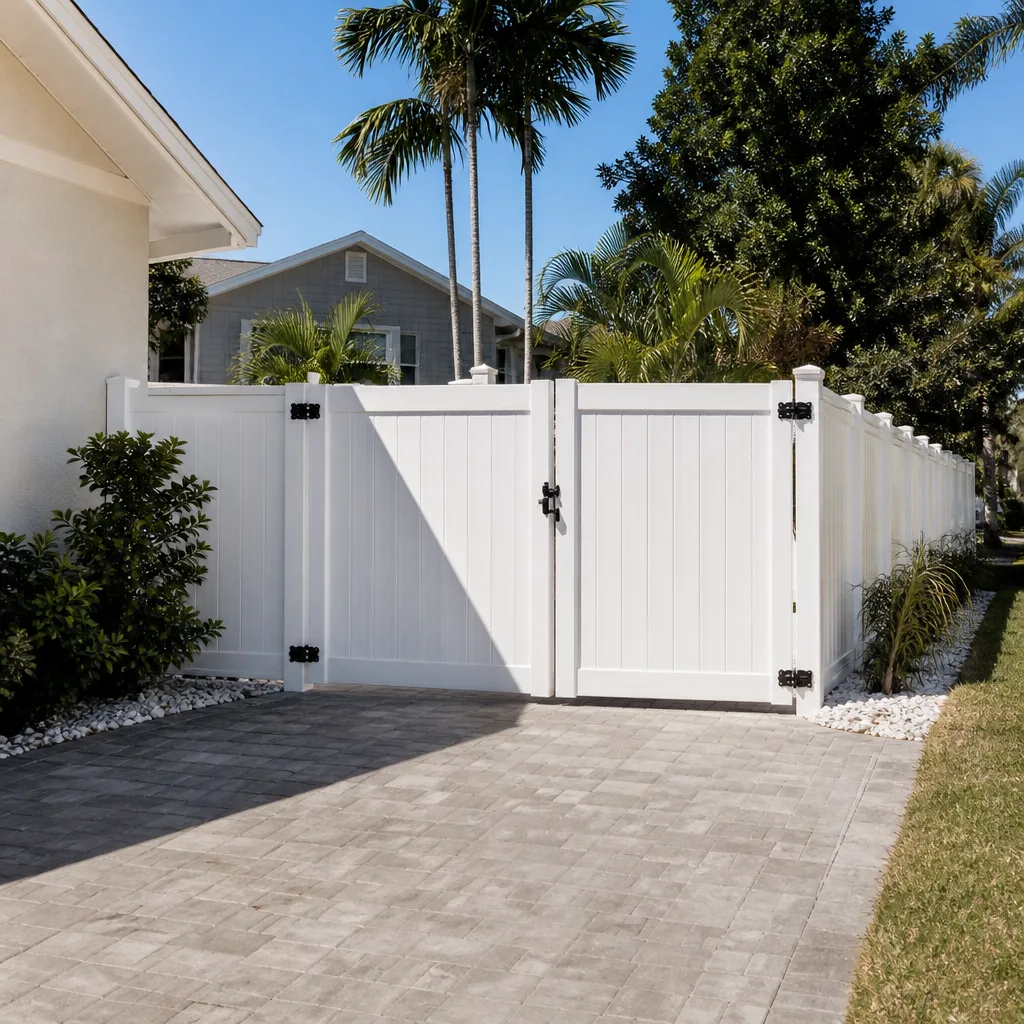
- Standard 6-foot vinyl panels (though color matching across manufacturers isn’t guaranteed, a local supply house usually stocks two or three common whites and tans)
Replacement turnaround on standard panels is often same week. A 6-foot panel from a Miami Gardens supply house typically runs $45 to $120 depending on material and species, plus installation.
Manufacturer-specific systems are the catch. Fences built with a proprietary rail bracket, a specific extrusion profile, or a decorative top rail from a named manufacturer like a decorative aluminum or composite product line need the original manufacturer’s part. That’s a 2-to-4 week lead time in most cases and a 20-to-40% premium over standard material. When we install a proprietary system, we recommend the homeowner keep one spare panel and two spare brackets on hand – it’s a $150 insurance policy against a $900 repair later.
If you’re sorting out which kind of fence you have, look at the rail connection. Pockets and through-bolts are almost always standard. Extruded brackets with a stamped logo are almost always proprietary. Our team can identify most systems from a photo if you’re unsure.
Wind Debris Damage and What It Really Costs
Wind-driven debris is the other big failure mode in Miami Gardens, and the pattern is consistent: it’s not the wind that damages the fence, it’s the palm fronds, tree limbs, and whatever the neighbors didn’t tie down. A 6-foot privacy fence catches wind load like a sail during a named storm, and the panels that fail first are the ones that weren’t installed with adequate post spacing.
What a post-storm inspection should cover, in order:
- Walk the full run looking for panel displacement – a panel that’s pushed partially out of its rail channel is a hazard, not just a nuisance, and it can take a pet or a child through it if it’s loose enough.
- Torque-test every post using the method above. A storm can loosen footings without breaking the post, and you won’t see it in a visual walk.
- Check gate hardware and hinges – a 6-foot gate that’s been slammed by wind is the most common hardware failure we see after a storm.
- Look for impact marks on rails and panels even when nothing appears displaced, because a rail that’s been struck but not broken can crack at the fastener line over the following months.
Typical repair costs in Miami Gardens after a storm: a single panel replacement runs $150 to $400 installed; a gate re-hang and hardware replacement is $200 to $350; a post replacement is $600 to $1,200 as above. If more than three panels in a run are damaged, the math usually favors replacing the run section – which is also a good time to look at footing depth on every post so the whole line is brought up to current wind-load expectations. Our Driveway & Pavers in Miami Gardens page covers what fence and paver replacement run together when a storm takes both.
What a Repair Scope Should Say in Writing
A fence repair is a small job, and small jobs are where contractors get vague. That vagueness is where a $200 repair becomes a $600 invoice. Any written scope you receive – including ours – should include these four things, and should never be delivered over the phone:
- The exact scope of work. “Repair leaning post” is not a scope. “Excavate 18 inches around post at 412 NE 171st, remove existing 8-inch collar, form and pour 11-inch collar to 30-inch depth, backfill and compact, reattach 6-foot pine panel with two galvanized brackets” is a scope.
- The footing specification being used. Diameter, depth, and gravel bed. This is the number that determines whether the repair lasts or doesn’t, and you should be able to compare it to the standard in one line.
- The warranty on the repair, stated separately from the original installation. A repair on a fence that’s outside its original installation warranty window should still carry its own warranty on the repair itself – ours carries the 365-Day Done Right Promise, which applies to the work done even when the fence around it is older.
- What happens if more damage is found once the post is out. The footing can hide more than the post does. A written scope should say what happens if the rail system or an adjacent panel is compromised. Under Clause 1 of the Haven Standard, no additional work proceeds without a signed change order – so you should see, before work starts, what additional work would trigger another signature.
If a contractor won’t put those four items in writing before you authorize the work, that’s not a fence contractor worth hiring. A written price before any work starts is the whole point of what we do, whether the job is a leaning post in Miami Gardens or a Home Additions & ADU in Miami Gardens.
Common Mistakes to Avoid
- Replacing the post without inspecting the footing. This is the single most expensive mistake in this guide. The old post comes out, a new one goes in, and the same lean returns within two to three hurricane seasons because the footing that failed the first time is still undersized.
- Assuming the worst because the fence is leaning. Many leaning posts are sound. A torque test with a 2×4 and a measuring tape takes 10 minutes and can save $800 on the same problem.
- Over-tightening fasteners on aluminum fences. A galvanized bracket over-tightened against an aluminum post digs through the oxide layer and starts corrosion the day it’s installed. Every aluminum bracket should be hand-tightened, not run in with an impact driver.
- Setting a post in concrete without a gravel base. Miami Gardens’ sandy, high-water-table soil needs at least 6 inches of drainage gravel at the bottom of the footing. Skip it and the post sits in standing water every rainy season.
- Buying standard stock panels for a proprietary system. The panel won’t seat in the rail channel, and you’ve spent the money anyway. Check the rail connection before you shop.
- Accepting a verbal repair scope. “We’ll fix it for three hundred” is not a scope and it’s not a warranty. Get the four items above in writing.
- Waiting until a storm season to inspect. A pre-season walk in April, before the rains and the named storm window, catches both the corrosion and the footing problems while they’re small. It’s two hours and it consistently saves the bigger repair.
See the difference
 Before
 After
 Before
 After
 Before
 After
When to Call a Professional
Some of what’s in this guide you can handle yourself: the torque test, the corrosion check, and the pre-season walk are all homeowner-appropriate. Calling a professional makes sense when the post has to come out, when a footing needs to be enlarged, when an aluminum bracket has already detached a rail, or when more than two panels in a run are damaged. The footing work in particular is not a DIY job in Miami Gardens’ soil – the water table and sandy composition mean a footing that isn’t formed properly will fail, and it will fail with a post attached. We’ve also seen a surprising number of homeowner-installed posts that were set 18 inches deep in our soils, which is nowhere near enough depth for a 6-foot privacy fence. Rowan Construction Group Miami Gardens offers free estimates in Miami Gardens – call (844) 320-5198 to schedule one, and bring any quote you’ve already received; we’ll review it line by line at no charge as a second opinion.
Frequently Asked Questions
A leaning post repair in Miami Gardens typically runs $150 to $450 for the footing or epoxy route, and $600 to $1,200 for full post replacement with a properly sized footing. That spread is why diagnosis matters: the same visual symptom can land at either end of the range. Call (844) 320-5198 for an exact quote on your fence – estimates are free, and the written price comes before any work starts.
Yes, in most cases – roughly 70% of the leaning posts we inspect in Miami Gardens have sound wood above grade and can be fixed with epoxy injection or concrete collar expansion. The 2×4 torque test tells you which situation you have in about 10 minutes. If a screwdriver sinks into the post at the soil line, the wood has failed and replacement is the only durable option.
Two reasons: sandy, high-water-table soil that loosens around a footing during the rainy season, and undersized footings from earlier installations. The soil here drains fast but doesn’t compact the way clay does, so a footing that’s fine in other parts of the country undermines here over a few seasons. Our crews use 10 to 12-inch footings at 30 to 36 inches of depth with a gravel base, which is what our soil actually asks for.
That white residue is galvanic corrosion – the aluminum being consumed where it contacts a steel fastener or bracket, accelerated by Miami’s salt air. A scratched fastener head or a bracket that shifts under hand pressure means the joint is compromised. A per-joint fix runs $40 to $80; a detached rail plus a dropped panel is $400-plus. Call (844) 320-5198 and we’ll look at it in a free estimate before the rail goes.
Epoxy injection holds 3 to 5 years in Miami Gardens conditions. Concrete collar expansion holds 10-plus years when the post above grade is sound. Full replacement with a properly sized footing holds 15-plus years with ground-contact-rated pressure-treated lumber. The length of the repair is almost entirely dictated by the footing specification, not the repair type.
Not without your signature. If we find damage under the post that wasn’t visible on the surface – a broken footing, a rotted rail – the additional work is written into a change order and no work proceeds on the change until you’ve signed it. That discipline is the reason our projects finish within a few percent of the price quoted, and it applies to a $200 post repair the same as any larger job. Call (844) 320-5198 for a written scope and price before anything moves.
The Bottom Line
Fence failures in South Florida come down to two recognizable categories, and treating them as one is where homeowners overspend. Post failure means rot; footing failure means undersized concrete in sandy soil. Diagnose which one you have with the 2×4 torque test before you call anyone. Then match the repair to the diagnosis: epoxy at $150 to $300, collar expansion at $250 to $450, or full replacement at $600 to $1,200. Add a corrosion check on any aluminum fence, know whether your panels are standard or proprietary before you shop for replacements, and insist on a written scope that lists the footing spec and the repair-specific warranty. That’s the difference between a fix that holds and a fix that comes back in two seasons. You’ll find the rest of our work across the trades on the Rowan Construction Group Miami Gardens home page.
If you’re looking at a leaning post, a storm-damaged panel, or a run of corroded aluminum brackets, call Rowan Construction Group Miami Gardens at (844) 320-5198 for a free estimate. We’ll bring a written price, a documented photo record of what we found, and a scope that tells you exactly which footing specification the repair will use.
Written by the team at Rowan Construction Group Miami Gardens.