Last updated November 18, 2026


Free written scope consultation - allowances, timeline, and change-order rules on paper before a single trade is scheduled
Driveway & Pavers Maintenance Checklist for Miami Gardens Homeowners
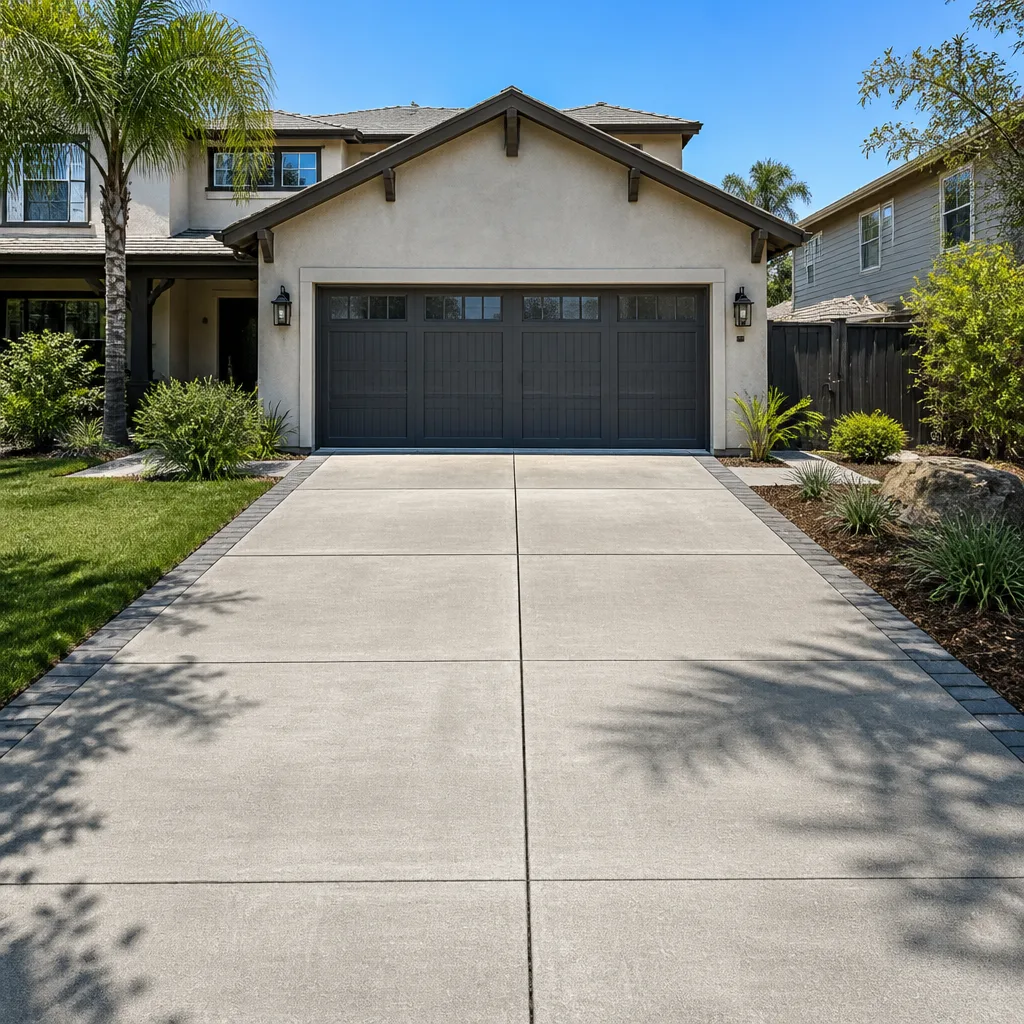
A paver driveway that looks fine in January can be rocking and separating by September. Not because the pavers failed, but because Miami’s roughly 60 inches of annual rain saturated a base layer that was compacted to 95% density when the spec called for 98%. The surface is almost never the problem. The base is. This checklist works backward from that failure mode: how to probe the base without lifting a single paver, which joint sand actually holds in South Florida humidity, and what each fix genuinely costs in Miami Gardens so you know whether you’re facing a $900 re-sand or a full rebuild.
Quick Answer
Most Miami Gardens paver driveway problems are base failures, not surface wear, and the cheap annual maintenance (re-sanding joints, clearing drainage, checking edge restraints) is what prevents a $12-$18 per sq ft rebuild. A 20-minute yearly inspection – rocking test, edge-gap measurement, center-line elevation check, and dated photos – catches base movement before it becomes a re-installation. Re-sanding costs roughly $1.50-$2.80 per sq ft; a full base rebuild costs $12-$18 per sq ft. Know which problem you have before you buy anything.
Styles & brands we work with
- Kitchen remodeling
- Bathroom remodeling
- Home additions & ADU
- Roofing
- Windows & doors
- Driveway & pavers
- Fence
Table of Contents
- How to Probe for Base Failure in 20 Minutes
- Choosing Joint Sand That Holds in South Florida Humidity
- The Miami Gardens Month-by-Month Maintenance Calendar
- Drainage: The Variable Nobody Checks Until It Rains
- What Re-Sanding Versus a Base Rebuild Actually Costs
- How to Document Base Conditions for Warranty and Insurance
- Common Mistakes to Avoid
- When to Call a Professional
How to Probe for Base Failure in 20 Minutes
You do not need to lift pavers to find out whether your base is moving. Four checks, done in order, tell you most of what an installer would learn on a service call. Walk the driveway in flat shoes, not barefoot, so you feel real movement rather than padding.
- Rocking test. Stand on each paver near the center of the driveway and shift your weight heel-to-toe. A paver that rocks underfoot has lost base contact beneath it. Mark it with chalk. Three or more rocking pavers within a few feet of each other is a cluster, and clusters mean base settlement, not a single bad stone.
- Edge-restraint gap measurement. The edge restraint is the concrete or plastic lip that locks the outer course of pavers in place. Slide a putty knife between the outermost paver and the restraint. If the gap exceeds about 1/8 inch (a nickel’s thickness), the pavers are spreading outward. Spreading edges are the single most common cause of joint sand loss in Miami Gardens driveways.
- Center-line elevation check. Lay a 4-foot level or a straight 2×4 across the driveway at three points – near the garage, mid-run, and at the street. Any spot where water would pool more than 1/4 inch deep is a low point, and low points hold water against the base. Ponding is the base’s enemy in a climate with this much rain.
- Joint-width check. Look down the joints between pavers. Joints should be uniform, roughly 1/8 to 3/16 inch. Widening joints near the edges and tight joints in the middle means the field is migrating.
If all four checks pass, you have a surface maintenance year. If two or more fail, the base is moving and re-sanding alone will wash out again within a season. That distinction is the whole point of this guide.
Choosing Joint Sand That Holds in South Florida Humidity
Standard mason sand is what gets swept into joints on a cheap job, and in Miami Gardens it is the wrong product. Plain sand does not bind; it rinses out with the first heavy rain and blows out in dry season wind. Polymeric sand is sand mixed with a polymer binder that activates when wetted, locking the joints into a semi-solid mass that resists washout and keeps weeds down. In a climate that delivers intense afternoon downpours through the summer wet season, that binder is the difference between joints that last years and joints that last one storm.
Two products we specify on our Driveway & Pavers in Miami Gardens work are Techniseal HP+ and Alliance Gator Bond, and they behave differently enough to matter:
- Techniseal HP+ is a high-performance polymeric sand with a finer aggregate and a strong binder that cures hard. It flows well into tight joints and holds up to the humidity swings between Miami Gardens’ wet and dry seasons. It’s the pick when joint widths are narrow and uniform.
- Alliance Gator Bond uses a coarser formulation and is forgiving on wider or uneven joints. It sets up firm but slightly more flexible, which helps on driveways with minor grade changes where a hard cure can crack along a joint line.
Both need the same prep to work: joints cleaned to a consistent depth, the surface bone-dry before application, and a light mist cure rather than a flood. Applied to a damp joint or over a base that’s still settling, either product fails early. If you are re-sanding because of edge spreading, fix the restraint first. Sand over a moving field is money down the drain.
The Miami Gardens Month-by-Month Maintenance Calendar
Miami Gardens’ weather is not a generic seasonal cycle. The Atlantic hurricane season runs June 1 through November 30, the wettest months are typically May through October, and the dry stretch from December through April is when joints open and weeds take hold. Maintenance timed to that calendar does more than maintenance done whenever you remember.
- January-February: Dry-season joint audit. Sweep, check for open joints, top off with fresh polymeric sand if gaps appear. This is the easiest window to re-sand because the surface is dry.
- March-April: Edge-restraint inspection and weed pull. Clean out any vegetation in the joints before the wet season gives it a growth spurt. Photograph the driveway now – it’s your clean baseline for the year.
- May: Pre-hurricane drainage inspection. Clear debris from the driveway’s low points, check that water runs to the street or a drain rather than pooling near the garage slab. Confirm nothing is blocking the flow path. This is the inspection that matters most.
- June-August: Wet-season watch. After heavy storms, walk the driveway and look for new rocking pavers or sand loss at the edges. Note anything that moved.
- September-October: Post-storm sand audit. Re-sweep and re-sand joints that washed out over the summer. Check edge restraints again – storms find weak edges.
- November-December: End-of-year photo record and any repairs. Fix small issues before the dry season hardens them into bigger ones.
If you track one thing all year, track the May drainage inspection. Water sitting against the base is what turns a two-year maintenance item into a ten-year rebuild. Our Rowan Construction Group Miami Gardens home page walks through how we scope a driveway assessment if you’d rather have a professional read the base condition once a year.
Drainage: The Variable Nobody Checks Until It Rains
A paver driveway is a drainage system disguised as a surface. The pavers are permeable at the joints by design – water is meant to pass into the joint sand and then into the base, where it moves to a graded outlet. When that path is blocked, water sits in the base, the base softens, and the pavers above it start to move. In Miami Gardens, where a single summer storm can drop an inch of rain in under an hour, a drainage problem that would be mild elsewhere becomes a base killer here.
What to check, and what it means:
- Low spots that pond after rain. If water stands for more than an hour after a storm, the driveway has lost its cross-slope or settled. That’s a base or subgrade issue, not a surface one.
- Water running toward the house or garage. A driveway should shed water away from the structure. If it slopes toward a garage door or a foundation, that’s a correction worth making before the next wet season.
- Clogged or missing outlet. Some driveways drain to a channel or a swale at the street. If that outlet is full of leaves and silt, the whole system backs up.
- Efflorescence and staining. White crusty staining on pavers after rain usually means water is moving through the slab or base and carrying salts to the surface. It’s a symptom of a water problem, not a cleaning problem.
Getting the drainage right is also a rule-of-thumb for how long the driveway lasts. A driveway that sheds water well will outlast a poorly drained one by years regardless of paver quality. Sakrete bedding mixes and Quikrete base products are common choices on Miami Gardens installs, and the brand of the paver matters less than whether the base under it drains.
What Re-Sanding Versus a Base Rebuild Actually Costs
This is where homeowners get misled. A surface repair and a structural rebuild are different jobs with different price points, and the cheap quote is usually just the surface job priced to look complete. In 2024-2025 Miami Gardens dollars:
- Re-sanding with a quality polymeric sand – roughly $1.50-$2.80 per sq ft. This includes cleaning joints, applying the binder, and curing. It fixes joint stability. It does not fix base movement.
- Full base rebuild – roughly $12-$18 per sq ft. This means lifting the pavers, re-grading and re-compacting the base to spec, resetting the edge restraints, and relaying the pavers with new joint sand. It’s the fix when the base has failed.
Here’s the math that matters. A 400 sq ft driveway re-sands for roughly $600-$1,120. The same driveway rebuilt runs $4,800-$7,200. Re-sanding a driveway with a failed base buys you one season before the sand washes out again, and you’ve paid twice. The rocking test and edge-gap check from earlier tell you which line item you’re actually facing. Do the 20-minute inspection before you accept any quote.
When we quote a paver job in Miami Gardens, the price is a flat written number with a written scope and a written warranty before work starts. No “call for a quote” – you get the number in writing. If a base rebuild is what your driveway needs, the quote says so and explains why. If it’s a re-sand, that’s the quote. A written price you can compare line by line is the only fair way to make this decision.
How to Document Base Conditions for Warranty and Insurance
This is the step almost every homeowner skips until a claim is denied. Dated photographs of the driveway tied to your property address create a record of the condition over time – which is what a manufacturer’s warranty or an insurance adjuster will ask for when something goes wrong. A photo taken this year and one taken the year before shows whether a crack or a settled area is new or long-standing, and that’s the difference between a covered claim and a denial.
A simple documentation routine:
- Photograph the whole driveway, edge to edge, in good light once a year, from a fixed spot. Same angle each time makes comparison easy.
- Take close-ups of any rocking pavers, widening joints, or edge gaps, with a tape measure visible in the frame so the measurement is provable.
- Label each file with the date and the address. A folder named for the property keeps it in one place.
- After any storm or repair, add a dated photo to the file. That’s your record if a problem resurfaces.
If you hire us, every visit already includes a documented photo record as a standard deliverable, not an add-on. You leave with evidence of what was found and what was done, tied to your job. That record is your warranty and insurance backup as much as it’s our documentation.
Common Mistakes to Avoid
- Re-sanding a driveway with a moving base. In Miami Gardens, homeowners often re-sand in spring and then see joints open again by September. If pavers rock, fix the base first; new sand over a settling field is wasted money.
- Using plain mason sand instead of polymeric sand. Plain sand rinses out with the first big rain and lets weeds seed. The wet season here is unkind to cheap joints.
- Ignoring edge-restraint gaps. A small gap at the driveway edge is the start of field spreading. Tighten the restraint before it becomes a re-installation project.
- Skipping the May drainage inspection. The single best timing for a Miami Gardens driveway check is right before hurricane season, when pooling near the garage or a low point can be corrected before the rains return.
- Power-washing at full pressure into the joints. Blasting water into the joints strips the binder and throws sand out. Wash the surface, not the joints.
- Keeping no dated record. Without dated photos tied to your address, you can’t prove when a problem started, and warranty and insurance claims often hinge on that timeline.
- Accepting a verbal price. The number you agree to verbally is not a number you can hold anyone to. Get it in writing with a written scope.
See the difference
 Before
 After
 Before
 After
 Before
 After
When to Call a Professional
Some paver work is homeowner-appropriate: topping off joints with polymeric sand, clearing drains, pulling weeds. Other work is not. If your rocking test finds three or more clustered rocking pavers, if your edge restraints have gaps wider than 1/8 inch, if the driveway ponds more than an inch after a storm, or if you see sinking near a garage slab or foundation, the base is the problem and lifting pavers to fix it is not a weekend job. Get a written assessment before you buy any sand. Rowan Construction Group Miami Gardens offers free estimates in Miami Gardens – call (844) 320-5198 – and we’ll show you the photo record of what we found so you can decide which repair is actually needed.
Frequently Asked Questions
Re-sanding with quality polymeric sand runs roughly $1.50-$2.80 per sq ft in Miami Gardens, and a full base rebuild runs about $12-$18 per sq ft. For a typical 400 sq ft driveway, that’s roughly $600-$1,120 to re-sand versus $4,800-$7,200 to rebuild. Call (844) 320-5198 for an exact quote – estimates are free.
Most Miami Gardens driveways need a joint top-off once a year, ideally in the dry season from December through April, with a post-storm audit in October. If joints open again within a few months of re-sanding, the base is moving and the sand is not the real problem.
Rain doesn’t damage the pavers themselves – it damages what’s underneath if the base was under-compacted or the drainage is poor. A base compacted to 98% density sheds water correctly; one compacted to 95% saturates and settles. That’s why the May drainage inspection before hurricane season matters more than surface cleaning.
If pavers rock when you shift weight and you find three or more rocking pavers clustered together, or the edge gaps exceed 1/8 inch, it’s a base problem. If pavers are firm and only the joints are low on sand, it’s a surface fix. Our 20-minute probe in this guide tells you which.
Yes, but not at full pressure into the joints. High-pressure water strips the polymeric binder and blows sand out of the joints, which undoes a re-sand. Use a fan tip and moderate pressure on the surface, and avoid aiming down into the joints.
Techniseal HP+ and Alliance Gator Bond are two polymeric sands that hold in Miami Gardens humidity. Standard mason sand doesn’t bind and washes out; the polymeric binder is what keeps joints stable through the wet season. Both products need a dry surface and a light mist cure to set properly.
The Bottom Line
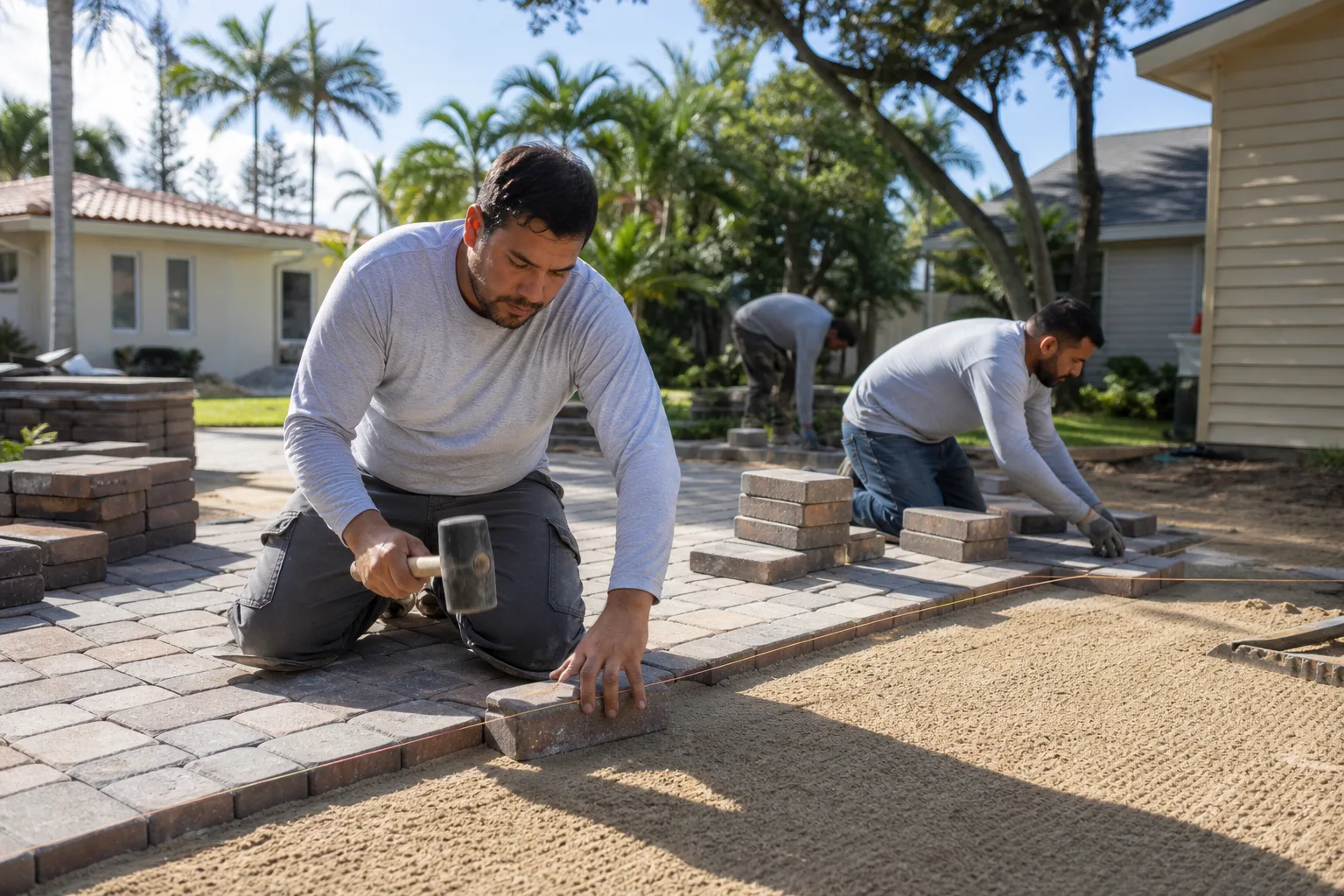
Your pavers will almost never fail. The base underneath them will, and the maintenance that prevents a rebuild is the stuff you can do without lifting a stone: a 20-minute annual probe, a polymeric re-sand in the dry season, a May drainage inspection before hurricane season, and dated photos tied to your address. Know the number in advance – roughly $1.50-$2.80 per sq ft to re-sand versus $12-$18 per sq ft to rebuild – so you can tell which problem you actually have. Do the cheap work on schedule and the expensive rebuild stays hypothetical.
When you want a professional read on your driveway’s condition, Fence Installation in Miami Gardens and Home Additions & ADU in Miami Gardens are two more exterior projects we scope on the same written-price discipline, and our paver crew applies the same photo record to a driveway assessment. Call (844) 320-5198 for a free estimate, and we’ll bring a written price before anyone touches a paver.
Written by the team at Rowan Construction Group Miami Gardens.