Last updated November 18, 2026


Free written scope consultation - allowances, timeline, and change-order rules on paper before a single trade is scheduled
Driveway & Pavers Troubleshooting: Common Problems and How to Fix Them
A single sunken paver isn’t a paver problem. It’s a base problem wearing a paver face. If you pull that one unit, add sand and set it back, the same hollow spot reopens in the same place within two rainy seasons, because the layer that actually failed sits 6 to 10 inches below the surface, where you never looked. In our experience across Miami Gardens, that misdiagnosis is the most expensive habit a homeowner can pick up. This guide teaches you to read failure patterns the way a contractor does: what each crack, crown and dip tells you about which layer gave way, how to run a two-minute probe test before you call anyone, and what each repair actually costs.
Quick Answer
Most driveway and paver problems trace to a failed base layer or a failed edge restraint, not to the pavers themselves. You diagnose them by reading the failure pattern (crowning, edge separation, random sinking, linear cracking) and confirming it with a simple screwdriver probe. Cheap spot fixes run $150-$400, edge restraint replacement costs $8-$14 per linear foot, and a full base rehabilitation is the only repair that stops a recurring failure for good.
Styles & brands we work with
- Kitchen remodeling
- Bathroom remodeling
- Home additions & ADU
- Roofing
- Windows & doors
- Driveway & pavers
- Fence
Table of Contents
- The Diagnostic Matrix: What Each Failure Pattern Tells You
- The Screwdriver Probe Test: Base Failure vs. Bedding Sand Washout
- Efflorescence vs. Spalling: A $300 Mistake vs. a Real Problem
- Repair Costs by Category: What Each Fix Should Cost
- Which Repairs Need a Miami-Dade Permit
- Edge Restraint: The Most Ignored Layer on the Driveway
- Drainage and Miami Gardens Soil: Why Water Does the Damage
- Sealing: What It Does and What It Can’t Fix
The Diagnostic Matrix: What Each Failure Pattern Tells You
Pavers fail in a small number of recognizable ways, and each pattern points to a specific layer. Read the pattern first. Before you call anyone, you should be able to say which layer failed, because the repair cost swings by a factor of ten depending on the answer.
Here’s how we read the four most common patterns:
- Crowning or tenting. The center of a section rises while the edges stay put. This points to edge restraint failure or root pressure pushing the field upward, or to tight joint spacing combined with heat expansion in unshaded sections. In Miami Gardens, west-facing driveways in the Andover and Norwood areas take afternoon sun hard enough that undersized joints show up as crowning within a few summers.
- Edge separation. A visible gap opens between the outer pavers and the driveway boundary, or the field spreads into the lawn. This is edge restraint failure, full stop. The paver edge locking the field has moved or degraded, and the whole field is drifting. Left alone, it progresses from a ¼-inch gap to a 2-inch spread in under a year.
- Random sinking or “birdbaths.” Isolated low spots, often several in a scattered pattern. This is base failure: either the compacted base wasn’t compacted to spec, or a subsoil layer is settling. Random sinking in a pattern that follows the direction of water flow usually means the base is being undermined from below.
- Linear cracking. Cracks running through multiple pavers in a straight line. Not a paver strength problem. It’s almost always a base problem along a seam, a shallow utility trench that was backfilled without proper compaction, or a paver laid directly on compacted soil with no aggregate base at all.
Most Miami Gardens driveways we inspect show two patterns at once, and the primary one is usually the edge. Get the edge right, and half the sinking problems stop recurring. That edge restraint question is the one we cover further down, but it’s worth knowing now that it’s the cheapest layer to fix and the most expensive to ignore.
The Screwdriver Probe Test: Base Failure vs. Bedding Sand Washout
Before you call anyone, run this two-minute test. It tells you whether the problem is the bedding sand layer (cheap, local) or the compacted aggregate base (deep, structural). Those two repairs share almost nothing but the word “sand.”
You’ll need a flathead screwdriver with an 8-inch shaft, or a stiff piece of rebar, and a spray bottle of water. If it’s been dry for more than five days, wet the suspect area lightly and wait fifteen minutes. Dry sand hides the diagnosis; damp sand doesn’t.
- Choose three probe points. Probe the center of one sunken paver, the joint between it and the next solid paver, and a nearby paver that isn’t sunken. Compare the three.
- Push the screwdriver down through the joint. Do not pry. Push straight down, slowly, with steady pressure. The joint is your entry point, not the face of the paver.
- Note the resistance at each depth. Smooth, sandy give for the first inch, then hard resistance: bedding sand is thin and the base is intact. Smooth give for two inches or more, then soft or no resistance: the bedding sand has washed out and the base may be compromised. No resistance at all past two inches: the base is gone and you’ve found your failure.
- Check the joint width on the way back up. If the joint opens more than 3/8 inch, the field has spread and the edge restraint has failed. Note it.
- Look at what comes up on the screwdriver. Clean sand is normal. Dark, wet, organic material means water is pooling under the surface and the base is losing bearing capacity.
Write down your three results before you call. When a contractor asks “what’s happening,” a homeowner who says “the screwdriver hits rock at two inches at the center but goes through soft sand at the east edge” is describing two separate repairs, and the quote should reflect that. That difference is the whole point of running the probe before pricing a repair.
Efflorescence vs. Spalling: A $300 Mistake vs. a Real Problem
Efflorescence is a harmless white powdery deposit on the paver surface. Spalling is structural loss of the paver’s top layer, and it’s a real failure. Homeowners confuse them constantly, and the confusion runs in the expensive direction: people pay to replace pavers that only needed a rinse and a wait.
Here’s how to tell them apart. Take a dry paintbrush and brush the surface. If the white powder comes off in a chalky dust and the paver surface underneath is smooth and solid, that’s efflorescence. It’s mineral salts that migrated to the surface with water evaporation and left behind a bloom. In Miami Gardens, where the water table is high and the rainy season runs from May to October, efflorescence on new pavers is nearly guaranteed. It typically burns off within one to three rainy seasons, and brushing it, or a mild efflorescence remover, handles it faster.
Spalling is different. Push on the surface with your thumbnail, into a dry paver. If the top layer flakes or chips away, exposing a rougher aggregate layer underneath, that’s spalling. It’s usually caused by two things: freeze-thaw damage (rare in South Florida, so treat this cause with suspicion unless the pavers came from a colder market), or a bad batch where the surface paste was over-watered during manufacture. On a driveway with spalling, replacement of the affected units is the right call.
The misdiagnosis cost runs both ways. Replacing pavers for efflorescence runs $12-$25 per square foot, for no reason. Ignoring spalling means the surface paste keeps failing and the pavers get progressively harder to seal or maintain. Brush it, then push on it. Two minutes settles it. Spalling on pavers under 18 months old is a warranty issue, not a repair – check the batch with your supplier before you spend anything.
Repair Costs by Category: What Each Fix Should Cost
Repair prices depend on square footage, access, and how much of the base needs work, but the ranges below are what we see in Miami Gardens and the surrounding trade area. A written quote should break these out line by line, not hand you a single lump number with no scope.
- Spot re-leveling (individual or small cluster of pavers): $150-$400. Includes resetting on fresh bedding sand and re-compacting. This is the fix for a localized bedding sand problem, not a base problem. If the base is compromised, this repair is a placeholder that fails within two rainy seasons.
- Edge restraint replacement: $8-$14 per linear foot. Includes removal of the failed restraint, fresh bedding, re-mechanical fastening or adhesive, and re-lock of the field. For a 40-foot driveway edge, budget $320-$560. This is the highest-value repair on most driveways.
- Full base rehabilitation: documented as a range in every written quote, typically priced per square foot and depending on access and haul-off. We won’t put a single number on this one here because the range spans a 4-inch lift over a compacted aggregate base up to a full excavation, and the difference is a factor of three. Ask for the line items before you sign.
- Drainage correction (regrading, adding a channel drain or French drain): priced per project, usually quoted with the repair, because fixing the base without fixing the drainage that killed the base is a re-do.
Two things to check on any quote: is the base prep line itemized at a specific depth (not “base prep” as a single word), and is the paver brand named? A Belgrad or Cambridge Pavers spec with a base depth named in inches gives you something to compare against. A quote that says “pavers and install” tells you nothing, and it usually leads to a change order. Rowan delivers a written price with a written scope before any work starts, on every trade, because “call for a quote” isn’t a quote.
If you’re comparing two written estimates for a driveway or a paver rebuild, you can bring a competitor’s quote in and we’ll review it line by line at no charge. That second opinion has saved customers in Miami Gardens from more undersized base pours than any other conversation we have. To schedule yours, call (844) 320-5198.
Which Repairs Need a Miami-Dade Permit
Most paver repairs don’t require a permit; most paver rebuilds and replacements do. In Miami-Dade County, the dividing line generally sits at structural work and full replacement, not at repair. The practical rule we use: if you’re removing and replacing the pavers in a given area, or changing the base depth, or touching drainage that ties into the storm system, plan for a permit. Spot re-leveling and edge restraint replacement typically don’t trigger review.
For a full driveway replacement, you need to check with the Miami-Dade County Department of Regulatory and Economic Resources (RER) building department before the first paver comes up, because the driveway slab, apron, and swale often fall under the right-of-way rules, and the permit set may need an engineer’s or surveyor’s documentation. That’s a municipal review, not a handyman call. If your driveway crosses a swale or meets the sidewalk at the apron, the county’s right-of-way rules apply, and a contractor who says “we do these all day, no permit needed” is telling you something about how they handle the rest of the job too.
One more Miami-Dade detail: the permitting threshold for driveway and paver work is tied to the scope of structural work and square footage, not just to the dollar amount. Ask any contractor to show you the permit number and the inspection record for a comparable driveway they’ve done. Not a photo. A permit number.
This is also where a written scope does the work. The scope should name the base depth, the paver brand, and whether a permit will be pulled and by whom. If the answer isn’t on the page, ask for it in writing before you sign. Our teams are background-checked and uniformed, and the permit and inspection documentation comes with the photo record of the job as standard.
Edge Restraint: The Most Ignored Layer on the Driveway
Ask any paver crew what they see on a failing driveway, and the answer is the edge. The edge restraint is the strip, usually aluminum or a concrete curb, that holds the field of pavers in place. It’s a 2-inch-wide piece of metal you never think about, and when it fails, the entire driveway spreads outward like a deck of cards fanning open. The pavers stay in place; the joints open; the rain gets in; the base softens; the driveway sinks. Every downstream failure started at the edge.
Miami Gardens accelerates this. The soil here is a mix of sand and muck depending on the block, and the rainy season saturates the ground from May to October. A properly fastened edge restraint and a well-drained subbase are what keep a driveway stable through that saturation. Undersized edge spikes, adhesive-and-nothing-else edge restraint, or a restraint set on uncompacted soil will work its way loose in two or three seasons, not ten.
What to look for:
- A visible gap between the outer pavers and the lawn, sidewalk, or driveway border
- Pavers you can wiggle by hand along the outer edge
- A sunken or tilted edge strip, or one that’s lifted up out of the ground
- Joint widths along the outer two rows that are wider than the interior joints
Edge restraint replacement runs $8-$14 per linear foot and it’s the cheapest structural repair on the driveway. It also happens to be the one that prevents the most expensive one. If you’re already considering work on the property, this is the repair to prioritize over any cosmetic sealing or cleaning.
Drainage and Miami Gardens Soil: Why Water Does the Damage
Pavers don’t fail from traffic. They fail from water, and water is what Miami Gardens has more of than almost anywhere. Most of the driveways we inspect with recurring sinking issues have a grading problem the homeowner never considered: the driveway slopes back toward the garage instead of away, or the gutters from the roof outlet onto the driveway surface, or the perimeter of the driveway has no positive drainage at all. The pavers get blamed; the grading is the culprit.
The fix sequence is fixed: correct the grading and drainage first, then repair the base, then reset the pavers. Doing the base repair first and the drainage correction after is paying twice. The correct slope for surface drainage is a minimum of 2 percent away from the structure, and the swale at the street needs to be able to carry the water it collects during a South Florida downpour. A 2 percent slope sounds like nothing. On a 20-foot-wide driveway, that’s about 5 inches of fall. It’s not nothing.
If the subbase is sand with a high water table (typical of blocks near the Snake Creek Canal and the low-lying areas nearby), you also need a properly compacted aggregate base with a geotextile separator to stop the subsoil pumping up into the base. Skipping the separator is one of the most common shortcuts we see, because the driveway looks right for the first two years. It’s the third year, after two rainy seasons, when the driveway starts telling the truth. The material spec matters here too: using a Quikrete or Sakrete aggregate base with the correct gradation and compaction, not just whatever sand the install crew had on the site, is what makes the difference in the record.
If a drainage problem is running under a fence line next to the driveway, that’s often a shared fix, and you can read about that in our guide to Fence Installation in Miami Gardens, because water that moves under a fence post line lands on the driveway edge. Grading and drainage are the start of the fix, never the last step.
Sealing: What It Does and What It Can’t Fix
Sealing is a surface treatment, not a repair. It slows water penetration at the surface and it slows UV fading on colored pavers. It will not fix a base failure, an edge restraint failure, or a low spot. Applying sealer to a driveway with an active base problem is like painting a wall with a leak behind it: you’ve covered the symptom, the failure continues, and the finish you paid for flakes off in a year.
When sealing is worth doing:
- On a newly installed driveway, after the pavers have had time to cure and the driveway has weathered at least one rainy season
- On a stable driveway with no active sinking, no edge spread, and no linear cracking
- As part of a maintenance schedule, not as a substitute for a repair
When sealing is a waste of money: on any driveway with an active base or edge failure, on newly installed pavers before the efflorescence has run its course, and on driveways without corrected drainage. In Miami Gardens, sealer applied just before the rainy season gets a lot of cheap traffic, and the honest answer is that a driveway with a settling problem needs a base fix and corrected grading, not a $400 seal coat. Any contractor who quotes sealing as the fix for a sunken paver is either not reading the failure or is hoping you won’t.
If the driveway gets a full rebuild, our team at Driveway & Pavers in Miami Gardens can walk you through the paver specification (Cambridge Pavers and Oldcastle among the lines we install) and the base depth, and we’ll give you a written price with the scope attached before any paver comes up. Same for larger hardscape work if the driveway ties into a household project, which sometimes makes sense alongside a Home Additions & ADU in Miami Gardens build where the driveway apron has to move anyway.
Common Mistakes to Avoid
- Resetting a single sunken paver without probing the base. That unit will sink again. The paver was never the problem. If the screwdriver hits soft material under the base, the repair has to start below the bedding sand.
- Sealing over an active failure. Sealer on a settling or spreading driveway is a $400-800 lesson in symptom treatment. It also makes the eventual repair harder, because the failed joint is now sealed and hidden.
- Skipping the edge restraint inspection. The most common failure we see in Miami Gardens is edge failure, and the fix is the cheapest structural repair on the driveway. Doing the full-field replacement without fixing the edge is the most common reason the replacement driveway fails on the same schedule as the original.
- Assuming white powder means the pavers are failing. Brush it first and push on the surface with your thumbnail. Efflorescence is cosmetic, spalling is structural, and the two look similar from ten feet away.
- Ignoring drainage before doing base work. A new base installed on top of a grading problem gets destroyed in one season. Correct the water path first, then compact the base, then set the pavers.
- Comparing lump-sum quotes without scopes. A quote that says “paver repair” with no base depth, no paver brand, and no drainage scope isn’t a quote. It’s a number. The line-item quote with the scope attached is the only one you can actually compare.
- Skipping the permit check on full replacement. A full replacement that touches the right-of-way may require a Miami-Dade County RER permit. The contractor who says “no permit needed” without looking might be right, but you’ll want that confirmed in writing, not assumed.
See the difference
 Before
 After
 Before
 After
 Before
 After
When to Call a Professional
Call a professional if the probe test shows no resistance below two inches, if the edge restraint has moved or lifted, if linear cracks run through more than three pavers, or if the driveway has been repaired in the same spot once already. Call if the driveway slopes back toward the house or garage, if you’re comparing a full-replacement quote above $10,000, or if a contractor quotes a repair without having run a probe test. Call if the paver surface is spalling on pavers under 18 months old, because that’s a warranty conversation before it’s a repair conversation. And call if the driveway is one part of a larger project (an addition, a fence line, a new APRON where drainage ties in), because sequencing those repairs well saves real money. Rowan Construction Group Miami Gardens offers free estimates in Miami Gardens and a free second opinion on any written estimate you already have. Call (844) 320-5198.
Frequently Asked Questions
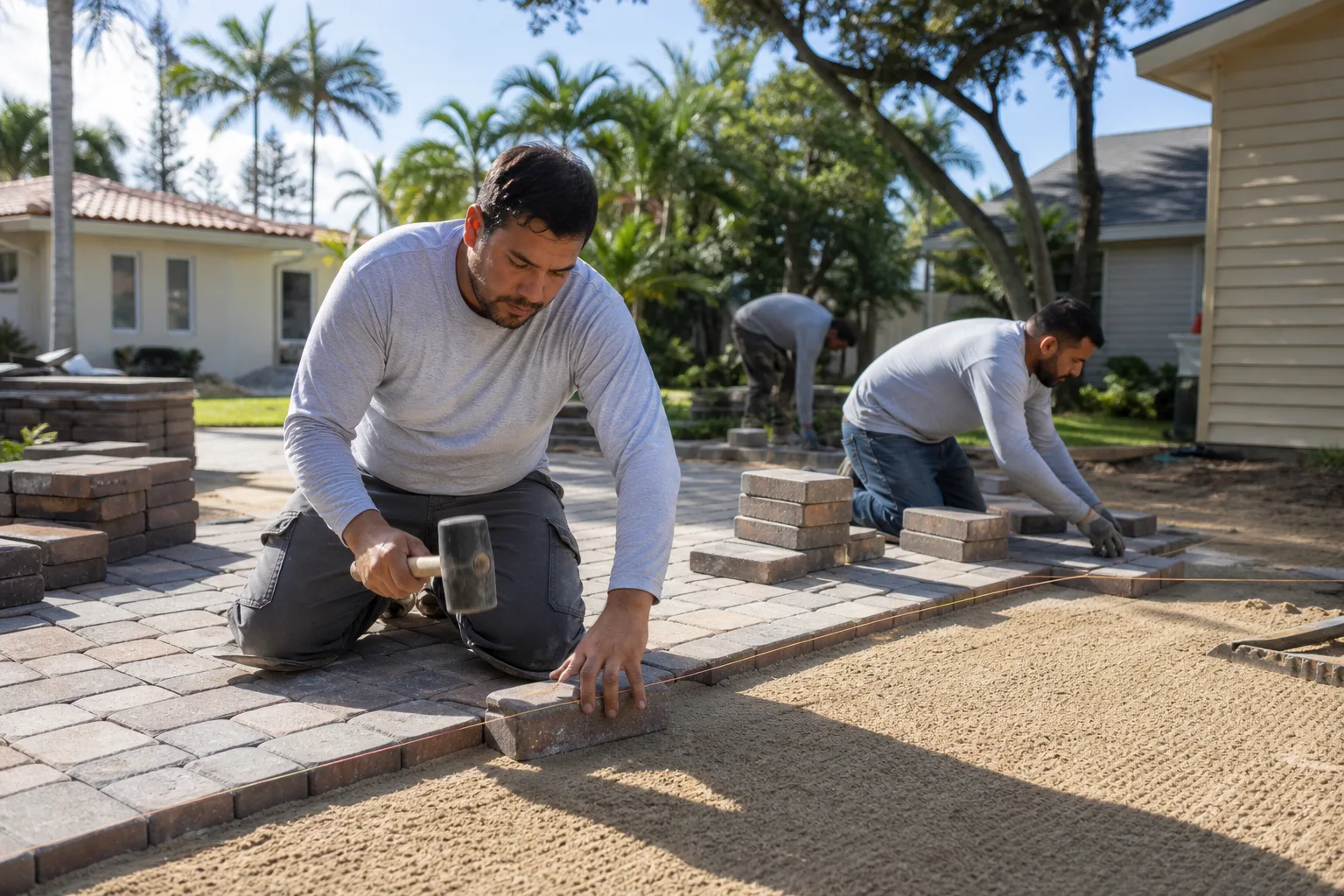
Because the repair is addressing the paver and not the base. A single paver that keeps returning is sitting over a base that was never properly compacted or has been undermined by water. Fixing the paver without fixing the base or the drainage that’s washing the base out puts your new repair on the same timer as the old one. The probe test separates the two, and the fix follows the base, not the paver.
Spot re-leveling runs $150-$400, edge restraint replacement runs $8-$14 per linear foot, and full base rehabilitation is quoted as a line-item range per square foot depending on base depth and access. A 40-foot edge replacement is typically $320-$560. The number that matters is which layer failed, so get a written quote with the scope itemized. Call (844) 320-5198 for a free estimate.
Most repairs don’t require a permit; most full replacements and work that changes the base or ties into the right-of-way do. The practical check is whether the work touches the apron, the swale, or the county’s right-of-way, and whether the existing base depth is being changed. Ask the contractor to name the permit status in writing before you sign. For a replacement, plan on checking with the Miami-Dade County RER building department first.
Usually not. White powder that brushes off into chalk dust and leaves a solid surface behind is efflorescence, a harmless mineral deposit that comes up with water evaporation. If the surface flakes or chips away under your thumbnail, that’s spalling, which is a genuine failure and usually a warranty matter on recent pavers. Brush first, then test the surface.
No. Sealing slows water at the surface and it does nothing for a base or edge failure, which is where sinking actually comes from. Sealing a driveway that’s actively settling also makes the eventual repair harder and wastes the money. Repair the drainage and the base first, then seal on a stable driveway when the time is right.
Line by line, on scope, not on total. Compare the base depth named in inches, the paver brand and spec (Cambridge Pavers and Oldcastle are the two lines we most often install), the edge restraint method, the drainage scope, and whether a permit is included. A repair quote with a single number and no scope isn’t a quote; it’s a number. Bring a competitor’s written estimate in and we’ll review it with you at no charge.
A paver driveway installed on a properly compacted base with a mechanically fastened edge restraint should last decades, even in South Florida’s rainy season. Most failures we see trace to the base or the edge, not to the pavers, which is why the failure pattern tells you more than the paver brand does. Fix the edge and the base, and the pavers do their job.
The Bottom Line
Read the failure before you buy the repair. The four patterns – crowning, edge separation, random sinking, and linear cracking – each point to a specific layer, and the probe test with a screwdriver confirms which one. Efflorescence is cosmetic; spalling is structural. Spot re-leveling, edge restraint replacement, and base rehabilitation have completely different price ranges and completely different lifetimes. Drainage precedes base work. Sealing fixes nothing that’s broken. Move on to the whole property when the driveway ties into a larger project, and start from the Rowan Construction Group Miami Gardens home page if that project spans more than one trade. A written price with the scope attached is the only quote worth comparing.
Call (844) 320-5198 for a free estimate and a free second opinion on any written quote you already have. Rowan Construction Group Miami Gardens answers the phone live, delivers a written price before any work starts, and stands behind the repair with the 365-Day Done Right Promise.
Written by the team at Rowan Construction Group Miami Gardens.